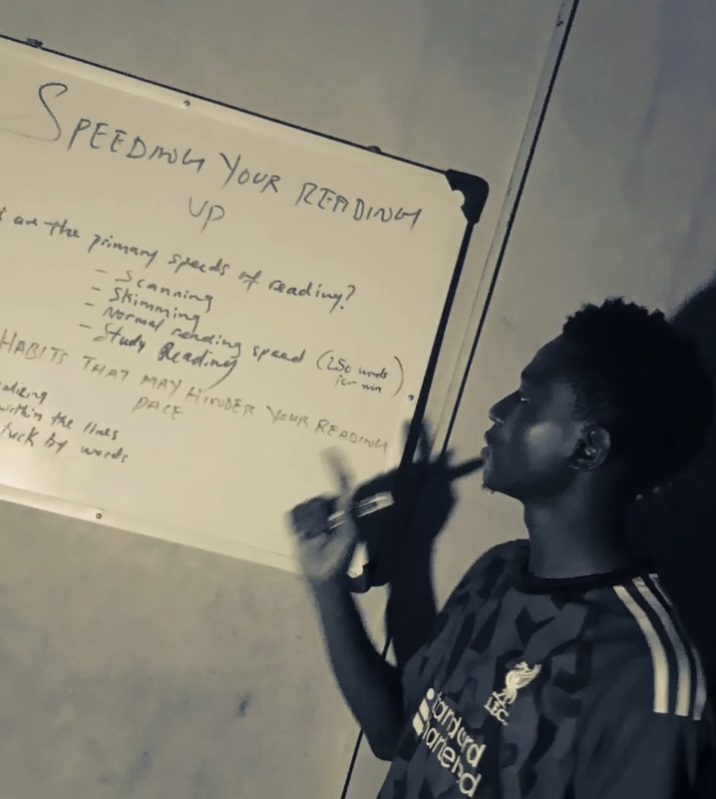
After making a video I consider too poor to address this topic, I now feel indebted to sit at my book and write this, since writing gives me all the time to choose the right words and edit properly before my work goes live. All this is not to override my introduction. This piece shall hold your hand through reading 250 words per minute. For clarity, that is a mere estimation, you could be reading more or less than that at the end of the day. Let’s get into it.
First, it is important to familiarize ourselves with the kind of reading speeds that there are:
- Scanning
- Skimming
- Normal reading
- Study reading
I am aware that some sources speak of quite some more, but I am particularly drawn to this OAU’s Manual on Communicative Skills’ own classification. What does it hold in my interpretation?
SCANNING
When you scan, you go about reading a piece in search of specific items (dates, names, figures, etc.) This idea makes scanning the fastest form of reading speeds. In scanning, your brain ignores every detail that is other than what you are setting out to get.
SKIMMING
This is the second fastest reading speed. It is the kind of reading you do when you don’t have all the time to examine a work properly word for word. Usually, you give a cursory look to get an overview of a given material. Readers sometimes do this by paying the most attention to topic sentences or central messages. The place of reading words in chunks rather than individually is also a feature here.
Confusing Scanning with Skimming?
We should not even lie about how closely related these two can be, one reason sources like the Wiktionary use ‘skim’ as their last reference for defining ‘scan’ as a noun in definition two.
A difference I chiefly advise you hold on to, nonetheless, is that scanning sees to fishing specific details while scanning wants an overview, ultimately affording you better comprehension of texts. So, scanning is faster than skimming.
NORMAL READING
Self-explanatory, I know. This is the kind of reading we have all had to do as learners, the only surprise that this is coming with is the generally held notion that it affords the average person some 250 words in about 0.8 minute or roughly 300 in a minute. Now that’d feel unrealistic to many who are not informed of the logic behind this so-called ‘Normal Reading’. This logic will be unveiled after we have addressed the major factors against you…
STUDY READING
This is thorough if not technical. You study-read especially so that you are put into some depth with the writer of a work. It is the kind of reading you do when you have to interpret a work, value/evaluate/appreciate it or answer non-literal questions on them.
Habits That Hinder Your Reading Pace
Perhaps there are a thousand and one habits that could be bad for fast reading, but I will be touching just three that I am most convinced about.
Sub/vocalizing. When you vocalize while reading, you sometimes or all through say words you see as you turn the pages…Usually, any attempt at vocalizing will set your reading pace back.
Subvocalizing. When you subvocalize, as opposed to vocalizing the words that you are tempted to say, are allowed to reecho in your mind. This is chiefly subconscious and many people who do it are scientifically said to never be aware of it.
Chewing a word or words in your head as you read is usually the reason you would sometimes realize that even though you have come to the bottom of a page, seemingly reading, your mind has not grasped past the first few sentences at the beginning of the page.
Vocalizing while reading may be bad but subvocalizing is a worse culprit.
Mapping within the lines. If you are fond of using an object to touch through lines as you read, then it is about time you gave up that habit. It is really bad for fast reading and as opposed to the reason you are doing it, it can easily trigger inattentivity. Let your eyes alone do the job of reading, because it is your eyes’.
Getting stuck by words. The dictionary is not some material you will exhaust or never stop needing to consult, so understandably, you may come across strange words as you read. Problem, however, sets in the moment you pay attention to every strange word. What you could do instead is, mark them with your highlighter and revisit after you have read.
To understand sentences packed with strange words, you must remember that English is highly contextual—words are not supposed to be treated as independent units, they should be viewed as a part of a larger unit.
An example is how words like ‘present’ may well mean at least four things hinging on usage. The term for that in linguistics is ‘polysemicity’. This should have convinced you further on the reason your dictionary may not be necessary in the first place.
On Reading 250 Words Per Minute
After every habit hindering your reading pace must have been put in check, there are two other things I will leave you with:
1. Working with the right psychology. We grow believing that spending more time on a text affords you better comprehension, contrary to the dude that reads everything in a few minutes. To that end, we traditionally make ourselves and our brain believe that we are better when we ‘do’ reading slowly. That doesn’t help things, by the way, in fact, quite the opposite is true. When you read fast, your eyes and brains are more concentrated because you have tricked them into believing that this exercise is important and urgent.
When you read slowly, on the other hand, your mind may be easily distracted since you are handing it enough time to wander around.
By this, I mean that one of the first few things to ensure is an intention to read fast. Be intentional about it.
2. On a final note, the hack is that fast readers are inherently skimmers. If you don’t skim, it is not mathematically possible to read at least 250 words per minute. Now you may need to go back to what I said about skimming or leave a comment if you need help with skimming. Happy reading.
Leave a Reply